What Is a Prop Firm? How Prop Firms Work in 6 Steps
By Fernando Funicelli · Founder of Lucky Dogs Trading Systems
A prop firm is a company that gives you an account to trade after you pass a paid evaluation. The profit is split with you, and the account's capital belongs to the firm: you get in by paying the evaluation fee, not by depositing the size of the account.
The name is short for proprietary trading firm, a firm that trades with its own capital. That is the prop firm meaning in one line: the firm puts up the money, and you bring the method.
The idea is appealing for a simple reason. You trade a 100,000 USD account without having 100,000 USD. If your method is good, it starts working on capital that is not yours, and part of the profit comes to you.
But that account comes with rules your own account does not have. A daily loss limit. A limit for the whole account. A target, sometimes with a deadline. And that is where many traders trip: not by trading the month badly, but by a single bad day that went past the limit.
The turning point is seeing what the firm really evaluates: a prop firm is a discipline test with someone else's money. And discipline is the one thing a robot never runs out of.
This guide explains what a prop firm is, how it works from challenge to payout in 6 steps, how prop firms make money, what each evaluation rule means and how to trade within those rules, by hand or with a robot.
What is a prop firm?
A prop firm is looking for one thing: traders who respect rules. Instead of hiring, it tests. Whoever passes the evaluation gets an account to trade.
What the firm offers:
- an account of a fixed size, which you choose at the start;
- a share of the profit you make, paid on the cycle set in the rulebook;
- at some firms, bigger accounts for traders who keep up the results.
What the firm asks for:
- the evaluation fee;
- the evaluation, with a profit target to hit;
- the rules, which apply during the evaluation and after it.
Many forex prop firms deliver the account on MetaTrader 5, with currencies, gold and indices. There are also futures prop firms, with their own rules. The model is the same for both: evaluation, account and profit split.
Prop firm vs. your own capital: the difference
| Prop firm | Your own capital | |
|---|---|---|
| Who puts up the money | The firm | You |
| Cost to get in | The evaluation fee | The whole deposit |
| Who takes the account's loss | The firm: you lose the fee and the account | You |
| Your share of the profit | The split set in the rulebook | All of it |
| The rules | The firm's: daily loss, total loss, target, deadline | Yours |
| If you make a mistake | Break a rule and the account is gone; to try again, another evaluation | The loss comes out of your balance, and the account is still yours |
| The lot | Fixed, sized from the firm's limit | Can grow with the balance, compounding |
It does not have to be one or the other. You can have both: your own account compounding, with the lot growing along with the balance, and the firm's account with a fixed lot, inside its rules.
How do prop firms work? From challenge to payout
The path has 6 steps, and the rules apply from start to finish:
- Choose the account size. The firm offers several sizes, and the fee goes up with the size. Choose by what your method needs, not by the biggest one on the menu.
- Pay for the evaluation. You pay the fee and get an evaluation account, with the rules already in force.
- Pass the evaluation. Hit the profit target without touching the loss limits, within the deadline, when there is one.
- Get the account. Once you pass, the firm hands you the funded account, in the size you chose.
- Trade under the same rules. The limits still apply. Breaking a rule here also ends the account.
- Withdraw your share of the profit. On the cycle set in the rulebook, you request a payout of your share.
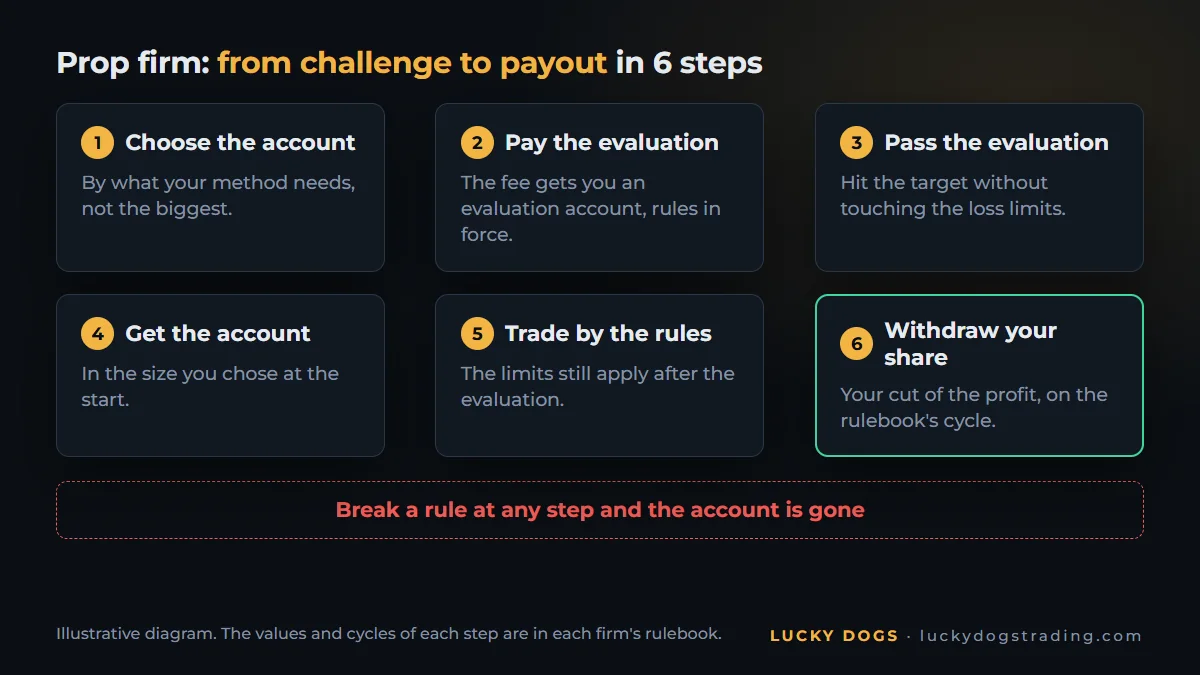
Anyone looking up how forex prop firms work finds this same flow. What changes from one firm to another are the numbers in each rule, the type of evaluation and the payout cycle. All of that is in the rulebook, and reading it before you pay is your first well-made trade.
One-step, two-step or instant funding
- One step: a single target. Hit it within the rules and you get the account.
- Two steps: a target in each phase, and the account comes after the second.
- Instant funding: the account comes ready, with no evaluation. The rules still apply, and the fee and conditions for this option are in the rulebook.
Which evaluation suits a rules-based trader
Two choices make a difference for anyone trading with a safe lot:
- No deadline. A good method with a small lot may need weeks to reach the target. A short deadline pushes you toward a big lot, and the big lot is what touches the limit.
- Static total loss, not trailing. With a static limit, the line stays put at the starting balance. With a trailing one, it rises behind your best balance, and each new high squeezes your margin.
How do prop firms make money?
A firm has two sources of revenue:
- Evaluation fees, paid by everyone who tries, pass or fail.
- Its share of the profit made by the traders running the accounts.
Why does this matter to you as a trader? Because it explains the rules. They exist to protect the firm's capital. And the trader who stays within them, month after month, is exactly the trader the firm wants to keep: that is who makes the profit split work for both sides.
Seen this way, the rulebook stops looking like a trap. It is the description of the trader the firm wants to pay.
Prop firm evaluation rules: what each one means
Each firm sets its own values, and the rulebook is the source. The names of the rules, though, repeat:
- Daily loss: how much the account can drop in one day, for example 5%. At many firms, it also counts floating losses, open positions in the red. And the "day" is the firm's server day, not yours.
- Total loss: how much the account can drop overall, for example 10%. It can be static, fixed at the starting balance, or trailing, rising behind your best balance.
- Profit target: how much you need to make to pass a phase.
- Deadline and minimum days: some evaluations have a deadline to hit the target, and some require a minimum number of trading days.
- Consistency: a cap on how much of the profit can come from a single day. The firm wants to see regularity, not one lucky day.
- News: some firms do not let you open or close positions in a window of minutes around major news, such as the interest rate decision of the Fed, the US central bank, and nonfarm payrolls, the monthly US jobs report.
- Weekends: some accounts do not allow positions open over the weekend, and some not even overnight.
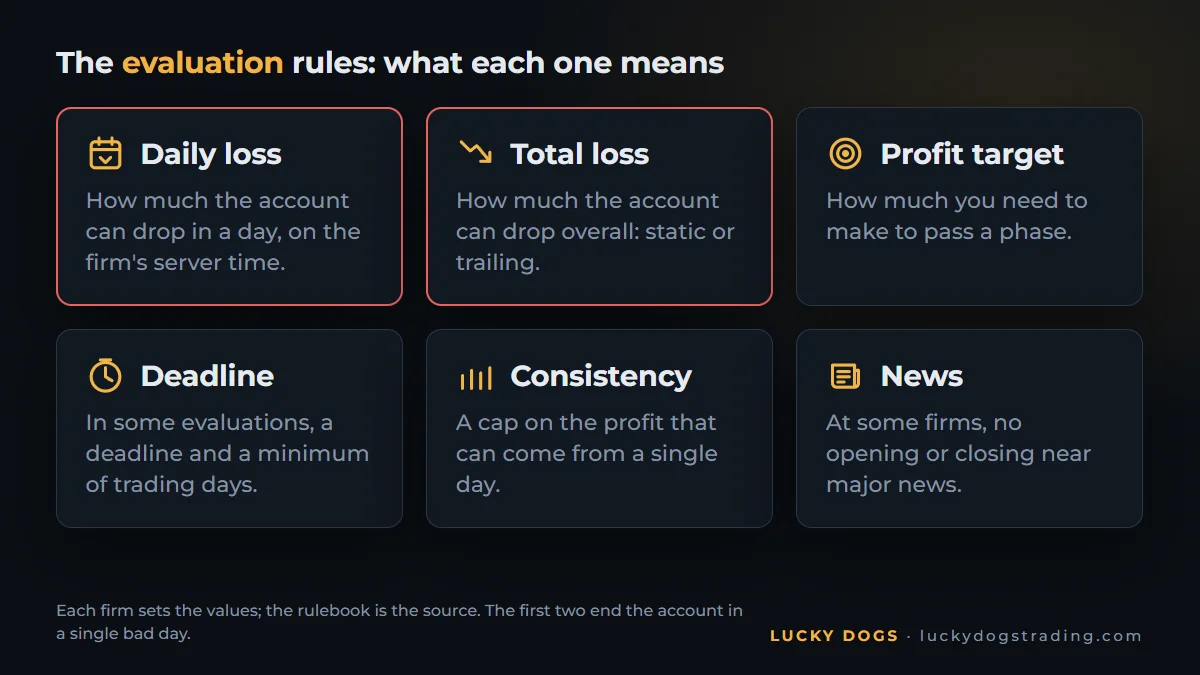
The first two need the most care, because a single bad day is enough to end the account. How to set up a robot for each of these rules is in which prop firms allow EAs: the 5 rules that decide.
How to trade a prop firm account
At a prop firm, the goal is not to make as much as possible. It is to reach the target without touching the limit. Four principles get you there:
- A small lot, sized by the limit, not by the urge. Take your method's worst streak and make it fit, with room to spare, inside the firm's total limit.
- Stop the day before the limit. A stop below the rule leaves room for the spread and for slippage, the difference between the requested and the executed price. If the firm cuts at 5%, stopping at 4.5% protects the account.
- Stay out of major news. Even when the firm does not forbid it, the minutes around the Fed and payrolls bring wide spreads and price jumps.
- Use a VPS if the robot trades at night. The daily loss keeps running with your computer off. A VPS, a cloud computer that stays on 24 hours, keeps MetaTrader managing every trade.
Notice that none of the four is about calling the market's direction. They are about size, when to stop and being there. That is why a prop firm is a discipline test.
By hand or with a robot?
By hand, the four principles depend on you every day. Including the day the account dropped in the morning and you want to win it all back in the afternoon. That is the classic mistake: the revenge trade that goes past the limit.
A robot set up for the firm follows the rule without getting tired:
- the fixed lot is the same on the first trade and on the hundredth;
- the daily stop closes everything at the point you chose, no negotiating;
- it does not try to win the day back after a loss;
- it is there in the middle of the night, while you sleep.
Two questions come before you turn it on. Whether the firm allows robots is a matter for the rulebook: see which prop firms allow EAs: the 5 rules that decide. And whether the robot is any good, you check before you pay for the evaluation: see how to test a trading robot before you buy.
The rehearsal takes an afternoon and costs nothing. Run the robot's free demo in the MetaTrader 5 Strategy Tester with the firm's account size, the fixed lot and real ticks. Find the worst day on the equity chart and compare it with the firm's daily loss limit. If it stays far away, the lot fits.
Our EAs on a prop firm account
Our three EAs trade gold on MetaTrader 5 and have a prop firm setup: a fixed lot and a 4.5% stop. The lots below are each one's official examples.
Pitbull Gold, with a fixed lot and the daily stop at 4.5%, is the most direct fit if you are starting out. The fixed lot is 0.03 on a 5,000 USD account and 0.60 on a 100,000 USD one. At a 4.5% loss on the day, it closes and pauses until the next day. Each trade has one entry, with the target and stop on the server from the first second, and it has a news filter you can turn on for the firm. On your own account, with the lot growing along with the balance, it closed 22 of 22 months in profit in 2025 and 2026, in the test with real ticks.
Beagle Gold, which fits the firm's margin from 6,000 USD, is for anyone who wants to fix the risk of each trade. The fixed lot is 0.01 on 10,000 USD and 0.15 on 100,000 USD. The drawdown protection, which watches how far the account drops, is set to "close and stop" at 4.5%: it closes the positions and stops the EA. Every trade enters with the stop on the server, and it never has more than two trades open.
Collie Gold comes in if your firm allows grid and hedging: short baskets, no martingale, a stop on every basket and the same "close and stop" protection at 4.5%.
The full table and the setup for each one are in how to set up each EA for a prop firm. To see all three with their 2025 and 2026 results, compare the three EAs side by side.
Frequently asked questions
Are prop firms legit?
It depends on the firm, and you can check before you pay. Four signs: the rulebook is public and complete; the payout rules say when, how and how fast you get paid; there are payout reports you can verify; and support answers in writing before you buy. If any of them is missing, look for another firm.
Are prop firm accounts simulated?
At many forex firms, the account is simulated: the orders do not go to the market, but the profit split is paid for real. Each firm's terms say what kind of account it uses, and that is also where the two things that matter to you are: the rules and the payout conditions.
Is there a free prop firm?
What is usually free is a trial account, to get to know the platform, with no profit split. The evaluation that earns you the account is paid. Some firms refund the fee with your first payout; the rulebook says whether yours does.
Can I join a prop firm from my country?
Each firm's rulebook lists the accepted countries and the payout methods. Check both before you pay: whether your country is on the list and whether the payout arrives in a way you can receive. The same goes for firms based in your own country: the rulebook decides.
How much does a prop firm cost?
The evaluation fee varies with the account size and the type of evaluation. Compare by the size your method needs, not the biggest one. If you go with a robot, its minimum lot decides the smallest size that works: in the official examples, Pitbull Gold starts on a 5,000 USD account, and Beagle Gold fits from 6,000 USD.
Do I need experience to trade a prop firm account?
You need rules. Experience helps you follow the rules on a bad day; a robot follows them out of the box. If you go with a robot, first see how to tell if a forex robot works and then set the fixed lot, the daily stop and the news filter to your firm's rules.
If you are going to trade by the rules, choose the tool that does not break them. See Pitbull Gold, with a fixed lot and the daily stop at 4.5%, and how to set up each of our EAs for a prop firm.