Martingale Strategy in Trading: What It Is and Why It Breaks
By Fernando Funicelli · Founder of Lucky Dogs Trading Systems

The martingale strategy in trading, also called the martingale system, means doubling the lot after every loss, so that the next win recovers everything lost and still leaves the profit of the first entry. The lot is the size of the trade, and in martingale it grows every time a trade goes wrong.
From the outside, the martingale strategy is beautiful. The curve only goes up, month after month. Almost every cycle closes in profit. The robot seems to have found the secret nobody else did.
Until the day gold moves in one direction for longer than the account can take. Six losses in a row, and the lot that was 0.01 is now 0.64. A few more, and the next doubling no longer fits in the account.
Martingale doesn't eliminate losses: it bundles all the small losses into one big one and saves it for the worst day.
This guide shows the full math: what martingale is, the table of the lot after each loss, why the curve looks perfect, why it breaks and how to spot martingale in a robot before you pay.
What is the martingale strategy in trading
Martingale was born as a betting system: lose, double; win, start over. The idea is that sooner or later a win comes and pays for all the previous losses. From gambling, it was carried over to trading.
In trading, it shows up in two ways:
- The lot doubles (or multiplies) after every losing trade. The next entry is bigger, to recover the previous one.
- The robot opens new entries against the price, each one bigger, and waits for price to come back to close everything at once.
In both cases, the rule is the same: the worse the trade goes, the bigger the next bet. And the loss is never accepted. The cycle only ends in one of two ways: with a win, or when the account can't take any more.
An example with 0.01 lot
Imagine a robot that always uses the same stop and target distance. Every 0.01 lot trade wins or loses the same amount. Call that amount 1.
- It enters with 0.01 and loses: −1.
- It enters with 0.02 and loses: −2. That's −3 so far.
- It enters with 0.04 and wins: +4.
Result of the cycle: +1. The 0.04 win paid for both losses and left exactly the profit of one 0.01 entry. That's what martingale delivers when it works: the profit of one small trade, cycle after cycle.
The martingale table: the lot after each losing streak
This table is the martingale calculator. It uses a starting lot of 0.01, a multiplier of 2 and equal stop and target. The last column shows how much has been lost so far, in multiples of the first loss.
| Losses in a row | Next lot | Accumulated loss (× the 1st loss) |
|---|---|---|
| 0 | 0.01 | 0 |
| 1 | 0.02 | 1 |
| 2 | 0.04 | 3 |
| 3 | 0.08 | 7 |
| 4 | 0.16 | 15 |
| 5 | 0.32 | 31 |
| 6 | 0.64 | 63 |
| 7 | 1.28 | 127 |
| 8 | 2.56 | 255 |
| 9 | 5.12 | 511 |
| 10 | 10.24 | 1,023 |
Read the last row slowly: after 10 losses, the robot risks 1,024 times the first lot to win the same profit as one 0.01 entry.
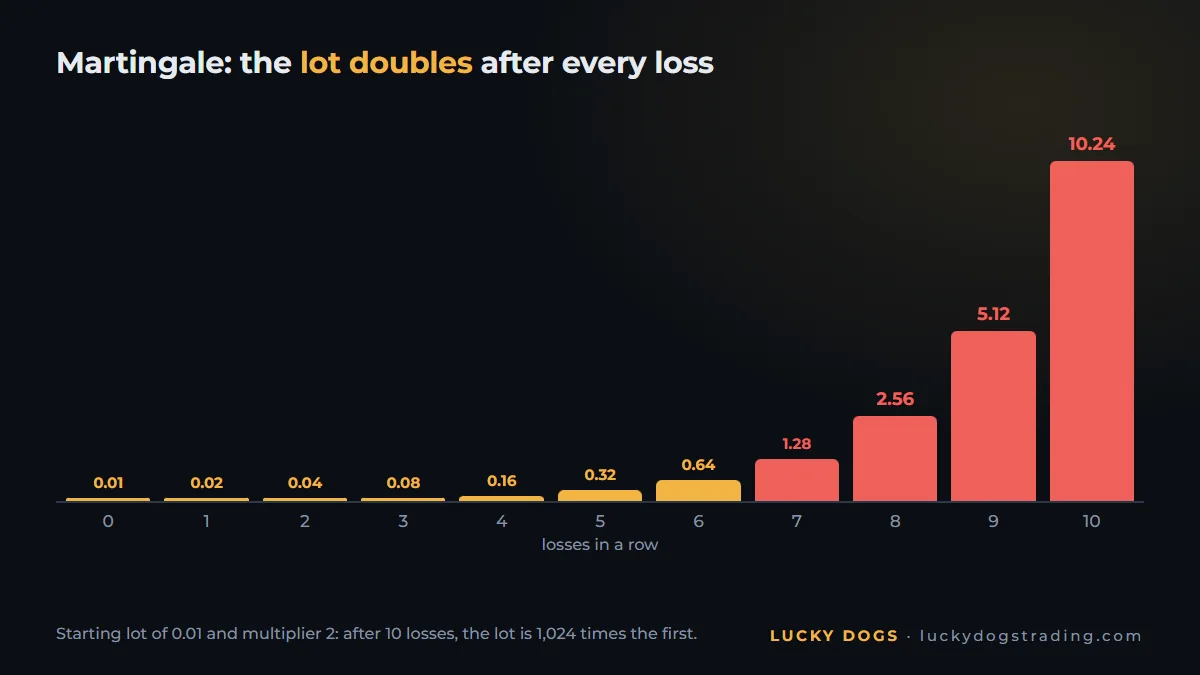
To calculate with your own lot, two formulas do the job, with equal stop and target. In them, n is the number of losses in a row:
- Next lot = starting lot × 2ⁿ (2 to the power of n).
- Accumulated loss = (2ⁿ − 1) times the first loss.
With a different multiplier, swap the 2 for it.
And with 20 losses in a row? The lot would pass 10,000 lots. No account gets there: it stops before, at one of the two limits you'll see below.
Why martingale looks perfect
Three things make a martingale curve look like the curve of a flawless system.
The win rate is sky-high. Almost every cycle ends in profit, because the loss doesn't happen: it's postponed to the next, bigger entry. A robot like this can show dozens, even hundreds of cycles in a row in the green.
The balance climbs like a staircase. The balance only changes when a trade closes, and in martingale the trades that close are the winners. Equity, which also shows what's open, tells another story. That gap has a recognizable look, drawn in the 7 warning signs of a forex robot.
Profitable months pile up. Month after month, until the month that takes it all at once.
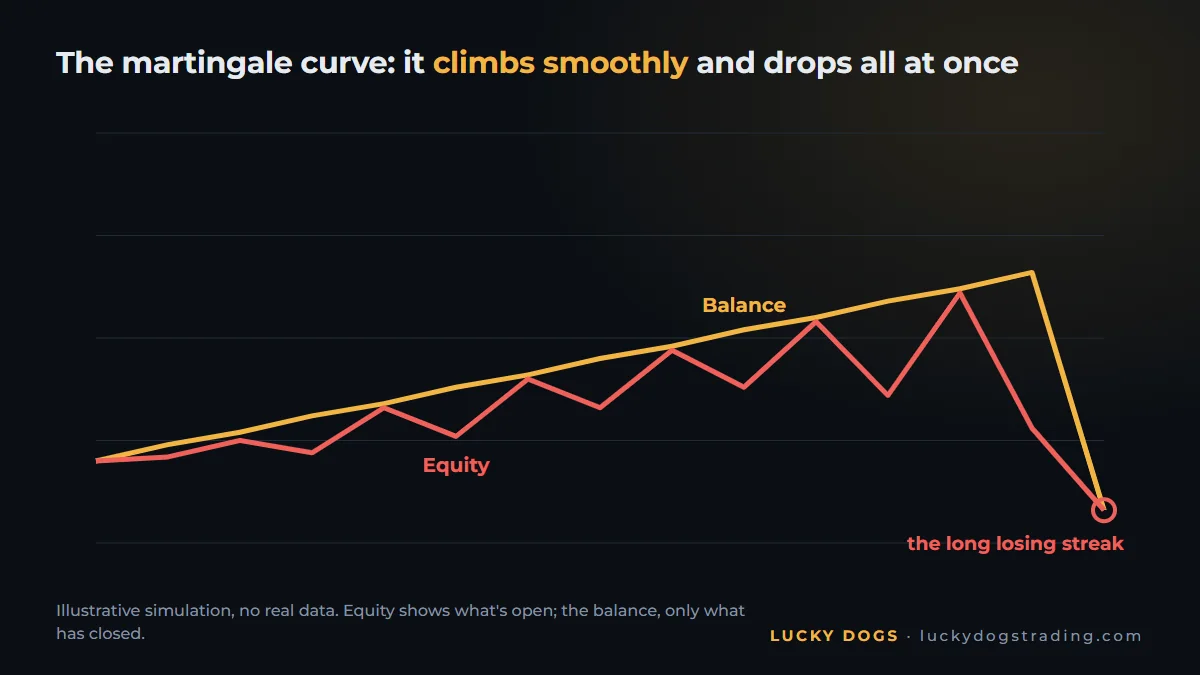
That's why a high win rate and months in a row in profit, on their own, prove nothing: not that the robot is a martingale, and not that it isn't. A serious robot can also win often and make money month after month.
What gives martingale away is in two places the pretty curve doesn't show: the lot after each loss and the stop.
Why martingale blows up the account
A bad streak is only a matter of time
On a fixed-lot robot, 8 losses in a row cost 8 losses. In martingale, they cost 255 times the first, and the next entry is 2.56 lots. And 8 losses in a row show up more often than you'd think.
The table below is math, not market statistics. It assumes a sequence of independent trades, like coin flips, and shows the chance of at least one streak of 8 losses in a row:
| Trades | Chance of at least 8 losses in a row (50% win rate) | With a 60% win rate |
|---|---|---|
| 100 | 17% | 3.6% |
| 250 | 38% | 9.2% |
| 500 | 62.5% | 17.7% |
| 1,000 | 86% | 32% |
With a 50% win rate, over 500 trades, the chance is 62.5%. With a 60% win rate, it drops, but it doesn't go away: over 1,000 trades, it reaches 32%.
Martingale doesn't ask whether the bad streak will come. It asks when.
The two limits: margin and maximum lot
The table alone breaks no one. What breaks the account are the two limits every account has.
Margin. Every open trade locks up part of the account as collateral: that's the margin. Every doubled lot locks up twice as much. When free margin runs out, the broker starts closing positions on its own, at the stop out, and the loss that was postponed becomes a real loss, all at once. Leverage lets you open bigger lots with the same account, but it doesn't change what each price move is worth. The details are in margin level and stop out in MT5 and in leverage and margin.
Maximum lot. Every broker has a maximum volume per order, which you'll find in the symbol's Specification in MetaTrader 5 (right-click in Market Watch). When the next lot in the table goes over that limit, the doubling doesn't happen. And without the doubling, the recovery doesn't come.
In gold, this matters. Long moves in one direction are part of gold's life, and they are exactly what pushes martingale into the last rows of the table.
Reverse martingale, smaller multipliers and averaging down
Martingale has variations. Some change how fast the account goes; one changes its direction.
Smaller multiplier. Instead of doubling, the robot multiplies the lot by 1.5. The math is the same, just slower: the lot keeps growing after every loss, and the streak that breaks the account only has to be a little longer.
Averaging down. The robot opens new entries on the same side while price moves against it, to lower the average price and get out of the red sooner. If the lot grows with each new entry, it's martingale under another name. If the lot is always the same and each group of entries has a stop, it's something else: it's a grid.
Reverse martingale (anti-martingale). The opposite direction: the lot goes up after a win and down after a loss. The bet grows with money that has come in, not with money that has gone out.
That's the direction of the lot that follows the balance, the one our EAs use: it only grows when the balance grows. It's compounding, never loss recovery.
How to tell if a robot uses martingale: 5 signs
You don't need to see the code to spot martingale. Five signs are enough, and you can check four of them yourself, in the free demo, before you pay.
- Ask the seller: "Does the lot go up after a loss? Does every position have a stop?" The right answers are no and yes. A vague answer means demo first, before any payment.
- Run the demo and look at the volume of each trade. In the Strategy Tester, the test's list of deals shows the volume of each one. A lot that doubles right after a loss is the clearest sign of all. The test checklist is in how to test a trading robot before you buy.
- Compare balance and equity. On the test chart, a smooth balance with equity taking deep dives means a losing position being held until price comes back.
- Look for several open positions on the same side, against the price, with a growing lot. With the same lot on every entry, it's a grid. With a growing lot, it's martingale.
- Check that every position, or every basket, has a stop. In the test, each order shows whether it had a stop. A position that only closes when price comes back is the other half of martingale: the cycle with no way out.
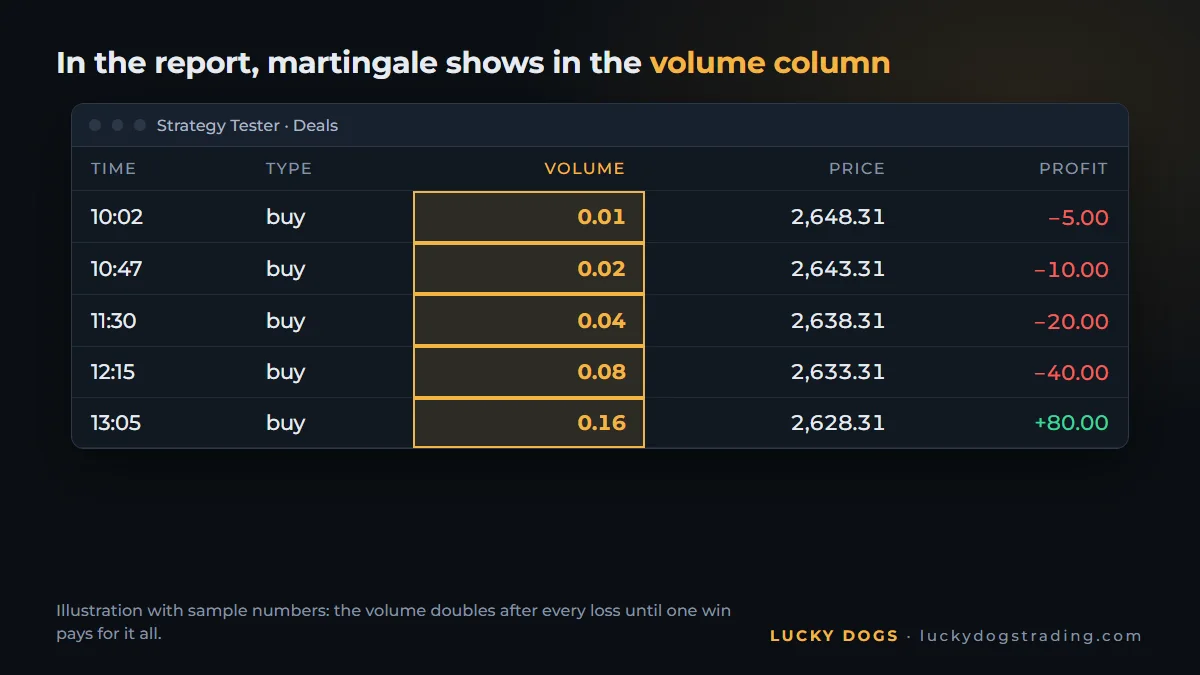
Notice what's missing from the list: the win rate. A high win rate, on its own, proves nothing. Martingale wins often because it postpones the loss, but a high win rate also shows up in robots that postpone nothing.
Real martingale doubles the lot after a loss and has no stop on the cycle. Open the test and check those two things. The rest is just a curve.
Our EAs don't use martingale
If a high win rate proves nothing on its own, that goes for ours too. That's why the numbers come with the two signs that give martingale away.
- Pitbull Gold: 22 of 22 months in profit in 2025 and 2026, in the test with real ticks. Every trade has one entry, with target and stop on the server from the first second. No grid, no averaging down: after a loss, the lot doesn't go up, because it only grows when the balance grows. In the same test, it made +425% in 2025 on the Balanced profile.
- Collie Gold: 1,999 of 2,022 baskets closed in profit, in the tests. It's a grid without martingale: every entry in a basket has the same lot, and every basket has a stop. The lot only grows when the balance grows.
- Beagle Gold: one entry per trade, with a stop on the server from the first second, and at most two trades open. You choose from 1% to 5% of the balance per trade, set before each entry.
Put all three through the signs in this guide:
| Martingale | Pitbull Gold | Collie Gold | Beagle Gold | |
|---|---|---|---|---|
| Does the lot go up after a loss? | Yes, it doubles | No | No | No |
| Does the loss have an exit point (stop)? | No: the cycle only ends in a win or at the margin | Yes, on the server, along with the target | Yes, every basket | Yes, on the server |
| Entries on the same side with a growing lot? | Yes | No: one entry per trade | No: the same lot on every entry | No: one entry per trade |
The Pitbull Gold and Collie Gold numbers have exactly the look this guide told you to investigate. And they pass the investigation: no loss turns into a bigger lot, and no position goes without a stop.
On all three, every win increases the lot of the next trades, the opposite direction from martingale. And each one's largest drop is published on its page, as the reference for sizing the account: 37% on Collie Gold, 48% on Pitbull Gold (in 2022) and 27% on Beagle Gold.
Compare the three side by side, with each one's largest drop, and run each one's free demo with the 5 signs in hand.
Frequently asked questions
Does martingale work?
It works until the losing streak the account can't take. Before that, it delivers the profit of one small entry per cycle. The probability table shows that, with enough trades, that streak arrives: the only question is when.
Is a robot with a high win rate a martingale?
Not necessarily. A high win rate shows up in martingale because the loss is postponed, but it also shows up in robots that postpone nothing. On a signal you might copy, the same math applies: how to choose a copy trader by the numbers. Check the lot after each loss and whether every position or basket has a stop. Collie Gold, for example, closed 1,999 of 2,022 baskets in profit in the tests, with the same lot on every entry and a stop on every basket.
Is martingale banned?
There's no general ban: martingale is a way of calculating the lot. Where it's often banned is at prop firms, which tend to put it on the list of prohibited strategies in their rules. Check yours in which prop firms allow EAs: the 5 rules that decide.
Is a grid the same as martingale?
No. A grid means opening several entries at different price levels. With the same lot on every entry, it isn't martingale; with a growing lot, it is. Collie Gold is a grid without martingale: every entry in a basket has the same lot, and every basket has a stop. More in our guide on grid trading: how it works and when the grid has a stop.
What is reverse martingale?
It's the opposite of martingale: the lot goes up after a win and down after a loss. The bet grows with profit, not with loss.
Is there a martingale calculator?
The table in this guide is the calculator: with a starting lot of 0.01 and a multiplier of 2, it shows the next lot and the accumulated loss up to 10 losses in a row. For another lot, use the formula: next lot = starting lot × 2ⁿ, where n is the number of losses in a row.
If martingale was your fear, start with Pitbull Gold, which enters with target and stop on the server: one entry per trade, and the lot only grows when the balance grows. Or compare the three side by side, with each one's largest drop in plain view.