What Is Copy Trading? How It Works, From Signal to Account
By Fernando Funicelli · Founder of Lucky Dogs Trading Systems
Copy trading means automatically copying another trader's trades into your own account: when they open a trade, your account opens the same one; when they close it, yours closes too. You don't make each entry. You decide who to copy.
The urge usually starts with a simple scene. You watch a trader call gold right week after week, open the chart to do the same and realize you can't. There's work, meetings, the commute. By the time you look again, they're already in, already out and already in profit.
Then comes the question everyone asks: what if my account did exactly what they do, the moment they do it?
Copying is the easy part. The hard part is knowing what you're copying. A screenshot of results can be edited in a minute. The history on screen may be just the best stretch, cut out after the weak months went by. And anyone who copies without checking finds this out with the account already running.
The rule that solves it fits in one sentence: in copy trading you don't copy someone's results: you copy their decisions. So only copy traders who let you check every single one.
This guide explains what copy trading is, how it works from signal to account, when it's worth it and what to check before you copy any trader.
What is copy trading
Every copy trading setup has three roles:
- The trader: the person running their own account, with their own method.
- The signal: every trade the trader opens, adjusts or closes. It's the instruction that travels to you: the asset, the direction (buy or sell), the size, the stop and the target.
- The copier: your account, which repeats every signal.
The stop is the price at which the trade closes to cap the loss. The target is the price at which it closes in profit. When both come with the signal, your copy starts out with its exit already set, the same as the trader's.
Copy trading shows up in forex, the currency market, in gold and in indices. Forex copy trading is the best-known name, but the mechanism is the same on any asset: only what the trader trades changes.
Copy trading vs. manual trading vs. a robot (EA)
There are three ways to have trades running in your account. None is best for everyone: each one suits a different kind of person.
| Manual trading | Copy trading | Robot (EA) | |
|---|---|---|---|
| Who decides the entry | You | The trader you copy | The robot's rules |
| Your screen time | All of it | Little: you follow along | Little: you follow along |
| What you choose | Every trade | Who to copy and how much of the account | Which robot and the profile |
| Where you check first | Your own history | The trader's history | The robot's test and the published account |
In MetaTrader 5, a robot is called an Expert Advisor, or EA: a program that opens and closes trades on its own, following fixed rules. The difference from copy trading is who decides. In copy trading, a person. In an EA, a rule.
Look at the last row of the table. In all three cases, a good choice starts with what you can check before you switch it on.
How copy trading works, from signal to account
On any copy trading service, the path is the same, in four steps:
- The trader trades their own account, as always. Nothing changes because they're being copied.
- Every trade becomes a signal: the asset, the direction, the size, the stop and the target. When they move the stop or close the trade, that becomes a signal too.
- Your account repeats the signal, at a size that fits it. Usually the copy is proportional to the size of your account.
- You follow along with every trade in your account, as if it were yours, and stop copying whenever you want.
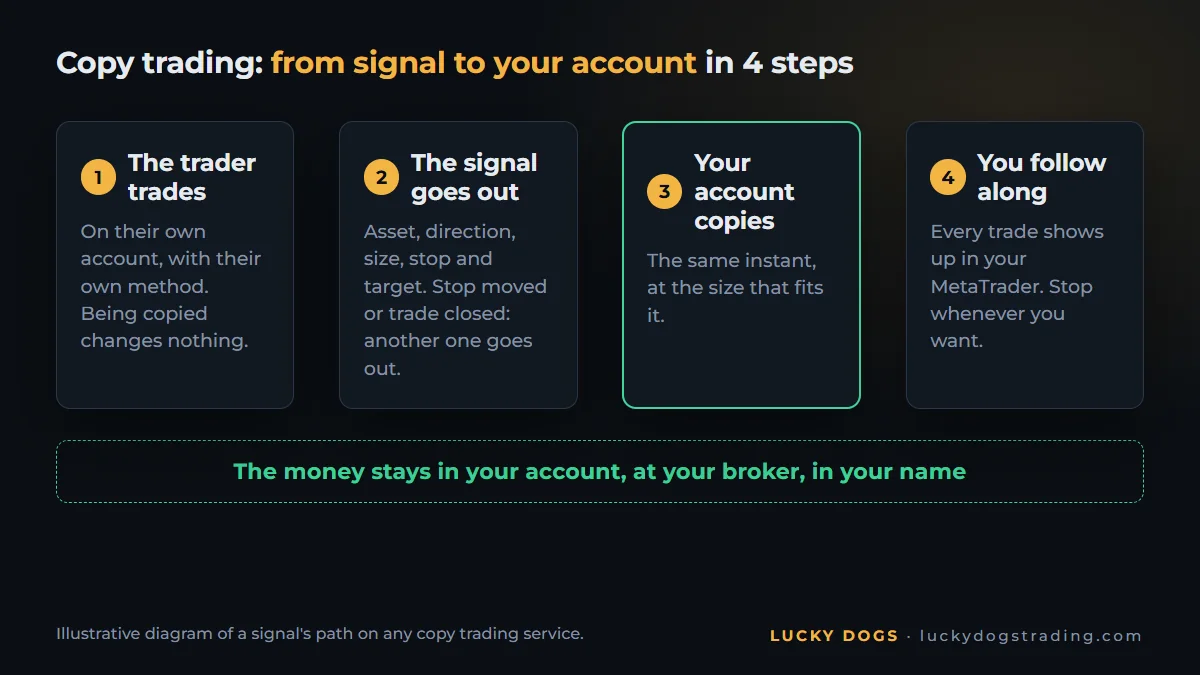
See what changes in your routine. You stop making dozens of small decisions, one per trade, and make one big decision, once: who to copy. After that, the job is to follow along.
And the money stays where it is. The copy happens in your account, at your broker, in your name. The trader never touches your balance: they trade their account, and yours repeats it.
Why the copy has to be real time
Price moves all the time. A signal read in a chat group and copied by hand, minutes later, gets a different price from the one the trader got. Sometimes a worse one, and that gap repeats on every trade.
On a short trade, a few minutes of delay can be the whole trade: the trader is already in and out, and you're still placing the order. That's why real copy trading is automatic. The signal goes out, and your account repeats it the same instant, in the middle of the night and in the middle of your meeting too.
The copy size: proportional to your account
Most services copy in proportion to the account. If the trader uses a slice of their account on a trade, your copy uses the same slice of yours. An example, just to show the math:
| Account size | Trade lot | |
|---|---|---|
| Trader | 10,000 USD | 0.10 |
| You | 5,000 USD | 0.05 |
| You | 1,000 USD | 0.01 |
The lot is the trade size in MetaTrader, and the smallest lot is usually 0.01. That's why an account that's too small can't keep the same proportion: in the example, with 500 USD, the copy would be 0.005 lot, which doesn't exist.
Before you start, check that your account is big enough to follow the trader at the minimum lot. It's the simplest math in copy trading, and the most forgotten.
How to start copy trading in 3 steps
Getting started is quick. What takes time, and should, is step 1.
- Choose who to copy by their history, not a screenshot. An account read straight from the broker, with every trade, from first to last. The full checklist is in our guide on how to evaluate a signal before you copy it.
- Have an account at a broker with MetaTrader 5. That's where the copy happens, and where your money stays.
- Follow the signal and keep an eye on it. Every copied trade appears in your MetaTrader, and you can check it in the phone app too. The step-by-step is in our guide on how to copy a signal in MT5.
Is copy trading worth it? What you gain and what you check
Copy trading is worth it if you want to be in the market without spending your day in it. What you gain:
- Time away from the screen. The trader watches the chart. You get on with your life.
- The method of someone who has traded for years. From day one, you use experience that would take you years to build on your own.
- Discipline. The decision doesn't go through your mood. After a loss, nobody tries to get even with the market in your account. After a win, nobody sizes up out of excitement.
- Learning by watching. Every entry shows up in your account, with its stop and target. Over time, you start to understand the why behind each one.
And what you check, because this is where you choose well:
- You copy the whole trader. The good days and the weak ones, because there's no copying just the winners. The history has to show both, and their worst month has to be a month you'd sit through without switching off the copy.
- The history has to be verifiable. Read straight from the broker, not typed in or photographed.
- The money stays with you. In your account, at your broker, in your name. Copy trading is your account repeating the trader's, never your money in someone else's hands.
The yardstick is simple: copy trading is worth it when you can check, beforehand, everything you're going to copy. And checking has a method.
What to check before you copy a trader
Four things separate a signal you can copy from a shop window:
- An account read straight from the broker. With the full history, from the first trade to the last. A screenshot doesn't count, and neither does a spreadsheet.
- Equity, not just balance. The balance only changes when a trade closes; equity also shows what's still open. A balance rising smoothly while equity sinks means a losing position being held.
- Time and consistency. One good month says little. The whole month-by-month record, weak months included, says a lot.
- Proof the history wasn't put together afterwards. A timestamp on every trade. Without it, nobody can prove the history wasn't put together afterwards, with only the trades that worked.
The numbers, one by one, are in our guide on how to evaluate a signal before you copy it.
100 to 100K: a signal you can check before you copy
Everything this guide asks of a trader, 100 to 100K shows in public.
It's a gold signal, traded by hand by a trader on a real account at Hantec. The account started with 100 USD on October 13, 2026, and the goal is to reach 100,000 USD. Every closed trade goes on the public scoreboard, read straight from the broker.
Three things make it a signal you can check before you copy:
- Copiers get it instantly; the public sees it later. The scoreboard shows trades already closed, with a 1-hour delay. Real time is for those who copy the signal: the delay protects them. It's the fifth of the 5 rules we publish every number by.
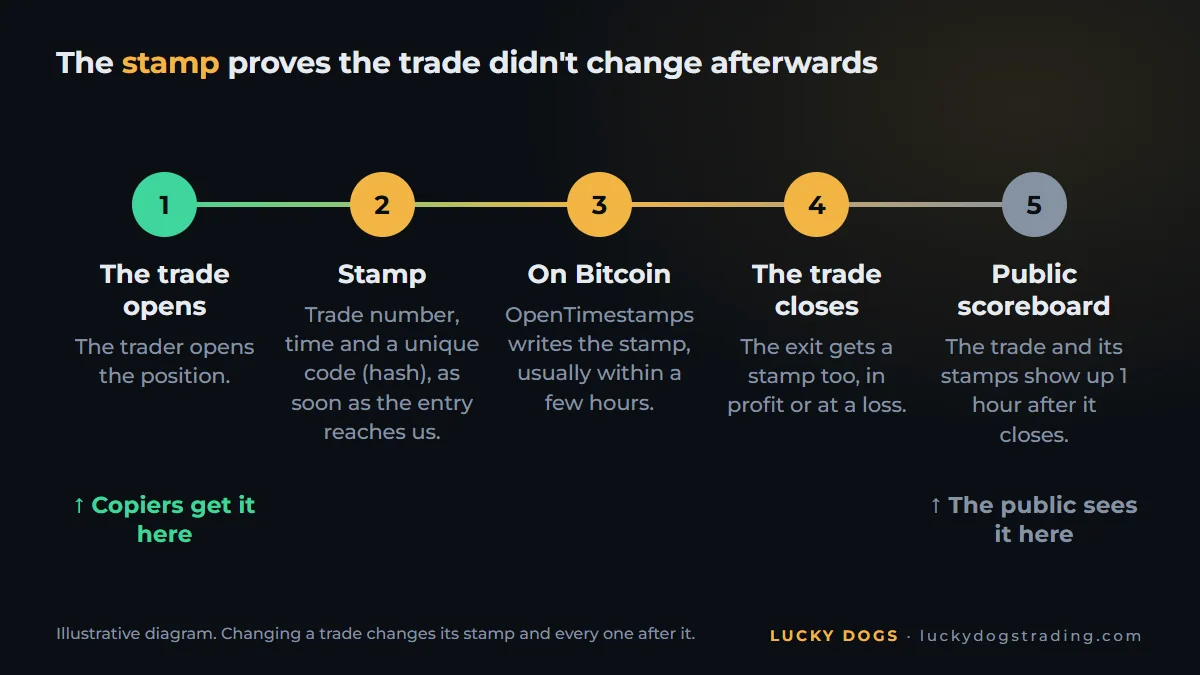
- Every trade gets a stamp as soon as the account records it and our service receives it, usually seconds later, on entry and on exit: a number, the time and a unique code (hash). The stamp goes straight to OpenTimestamps, which writes it into Bitcoin, usually within a few hours. Once it's there, it proves the trade hasn't changed since it was stamped.
- The chain never skips. The stamps are numbered in sequence, and changing a trade changes its stamp and every one after it. Copy a stamp and keep it: if it changes on the site, someone tampered with it.
The scoreboard numbers change every day, so they're not in this guide: they're there, up to date, with the full history. Follow the 100 to 100K scoreboard and, when you're ready, follow the gold signal and copy it.
Frequently asked questions
What is a trading signal?
It's the instruction for a trade: the asset, the direction, the entry price, the stop and the target. In a chat group, the signal arrives as text for you to execute by hand. In copy trading, it goes straight to your account, which repeats the trade.
Is copy trading safe?
It's as safe as what you check beforehand: an account read straight from the broker, the full history, proof the signal came before the result and the money in your account, in your name. The criteria, one by one, are in our guide on whether copy trading is trustworthy and how to check.
Do I need to know trading to copy trade?
Not to copy: copying is automatic. It helps when choosing who to copy, and for that there's a checklist that needs no experience, in our guide on how to evaluate a signal before you copy it.
How much money do I need to start copy trading?
It depends on your broker's minimum lot and the copy ratio. Usually, a smaller account copies at a smaller lot, down to the 0.01 minimum. Before you start, check whether, at that lot, your account can keep up with the size of the trader's trades.
Is copy trading the same as a trading robot (EA)?
No. In copy trading, a person decides each trade. In a robot (EA), it's a rule that runs in your MetaTrader, the same every day. Both take you away from the chart; what changes is who decides. If you prefer the rule, see our gold EAs side by side.
Can I copy trade on MT5?
Yes. The copy happens in your MetaTrader 5 account, and every trade shows up in it as if you'd opened it yourself. The path is in our step-by-step guide on how to copy a signal in MT5.
Copying is easy. Choosing who to copy is what decides it. Start with a signal you can check trade by trade: follow the 100 to 100K scoreboard and follow the signal.
Rather have a rule trade for you? Meet our gold EAs, side by side: Collie Gold, Pitbull Gold and Beagle Gold all have a free demo you can run in your MetaTrader before you choose.