Leverage in Forex: What 1:500 Changes (and What It Doesn't)
By Fernando Funicelli · Founder of Lucky Dogs Trading Systems
Leverage in forex is how much your broker lets you trade beyond the money in your account: with 1:500, every 1 USD of margin holds 500 USD of position. It changes the margin the broker sets aside to open the trade. It doesn't change what each price move is worth.
You're opening an account and the broker asks: 1:100, 1:500 or 1:1000? The number is scary. 1:500 looks like five hundred times more risk.
It isn't. And people who confuse leverage with risk tend to fall into one of two opposite mistakes. The first is running away from a 1:500 account that would give you more room. The second is using that room to open a lot that's too big. The first costs comfort. The second costs the account.
The rule that separates the two: leverage decides how much you can open. The lot decides how much you win or lose.
Below are the margin math, with gold and with EUR/USD, the proof that the value of each move doesn't change, what changes between 1:100 and 1:500 on the same account and what leverage a gold robot needs.
How leverage works: the required margin
When you open a trade, the broker doesn't charge the full value of the position. It sets aside part of your money as collateral, the margin, and leverage covers the rest. The required margin comes out in two steps:
- The position value: lots × contract size × price.
- Divided by the leverage: position value ÷ leverage = margin.
In one line: margin = lots × contract size × price ÷ leverage.
With gold at 4,000 USD, for example, 1 lot is 100 ounces (what 1 lot of gold is worth): 400,000 USD of gold. With 1:500, the broker sets aside 400,000 USD ÷ 500 = 800 USD. On 0.01 lot, 8 USD.
That's what leverage does: you control 400,000 USD of gold with 800 USD tied up in the account. The rest of the balance stays free.
The gold margin table
Gold at 4,000 USD (example), 100-ounce contract:
| Lot | 1:100 | 1:200 | 1:500 | 1:1000 |
|---|---|---|---|---|
| 0.01 | 40 USD | 20 USD | 8 USD | 4 USD |
| 0.10 | 400 USD | 200 USD | 80 USD | 40 USD |
| 1.00 | 4,000 USD | 2,000 USD | 800 USD | 400 USD |
Use it as a calculator. If the gold price is different, the margin changes in the same proportion. And look at the diagonal: 0.10 lot at 1:100 ties up the same as 1 lot at 1:1000.
In forex: the same math with EUR/USD
On currencies, the contract is 100,000 units per lot at most brokers. With the euro at 1.10 (example), 1 lot of EUR/USD is worth 110,000 USD. With 1:500, the margin is 220 USD. On 0.10 lot, 22 USD.
Some brokers use a different leverage for gold than for the rest of the account. Check your account conditions before doing the margin math.
What leverage doesn't change: the value of each move
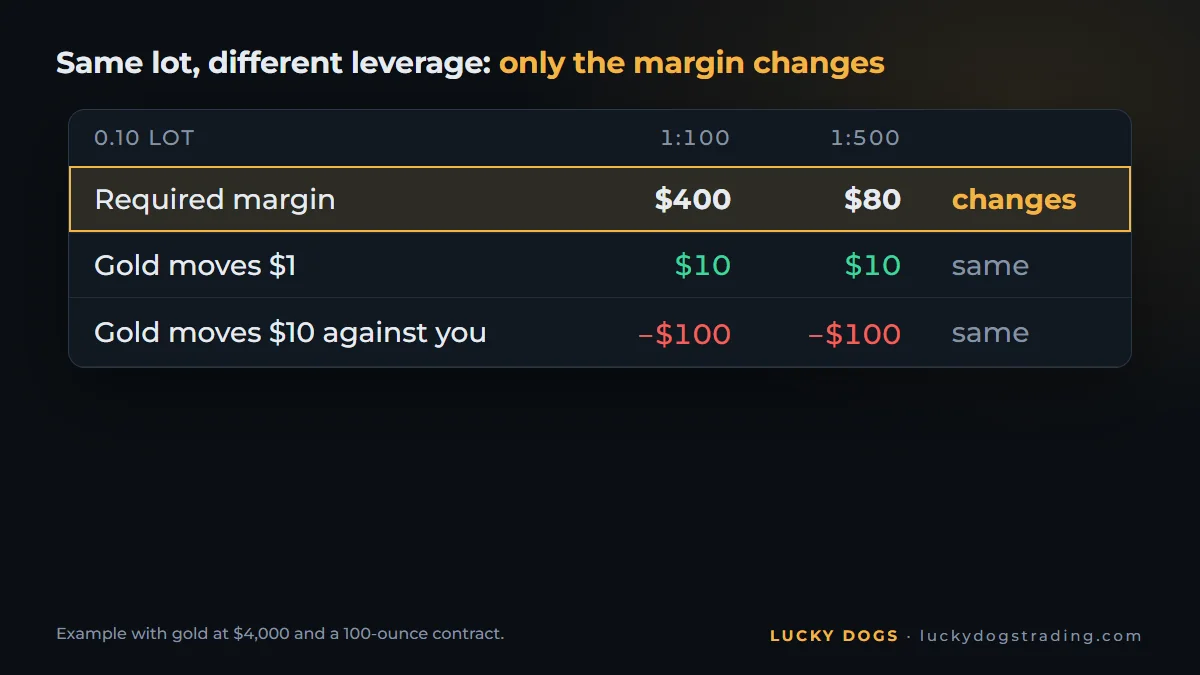
Now the part that confuses people the most. Take the same lot and change only the leverage:
| 0.10 lot of gold | At 1:100 | At 1:500 |
|---|---|---|
| Required margin (gold at 4,000 USD, example) | 400 USD | 80 USD |
| Gold moves 1 USD | 10 USD | 10 USD |
| Gold moves 10 USD against you | −100 USD | −100 USD |
The margin fell from 400 USD to 80 USD. Nothing else moved. Every 1 USD gold moves is worth 10 USD on 0.10 lot, at 1:100 or at 1:500. If it moves 10 USD against you, that's −100 USD on both accounts.
The same lot wins and loses exactly the same with any leverage. The value of each move comes from the lot and the contract, as what 1 pip is worth in forex and gold shows. Leverage doesn't even enter that math.
So where does 1:500's dangerous reputation come from? It lets you open lots that 1:100 wouldn't. The danger was never the leverage. It's the lot it allows.
1:100 or 1:500: what changes on your account
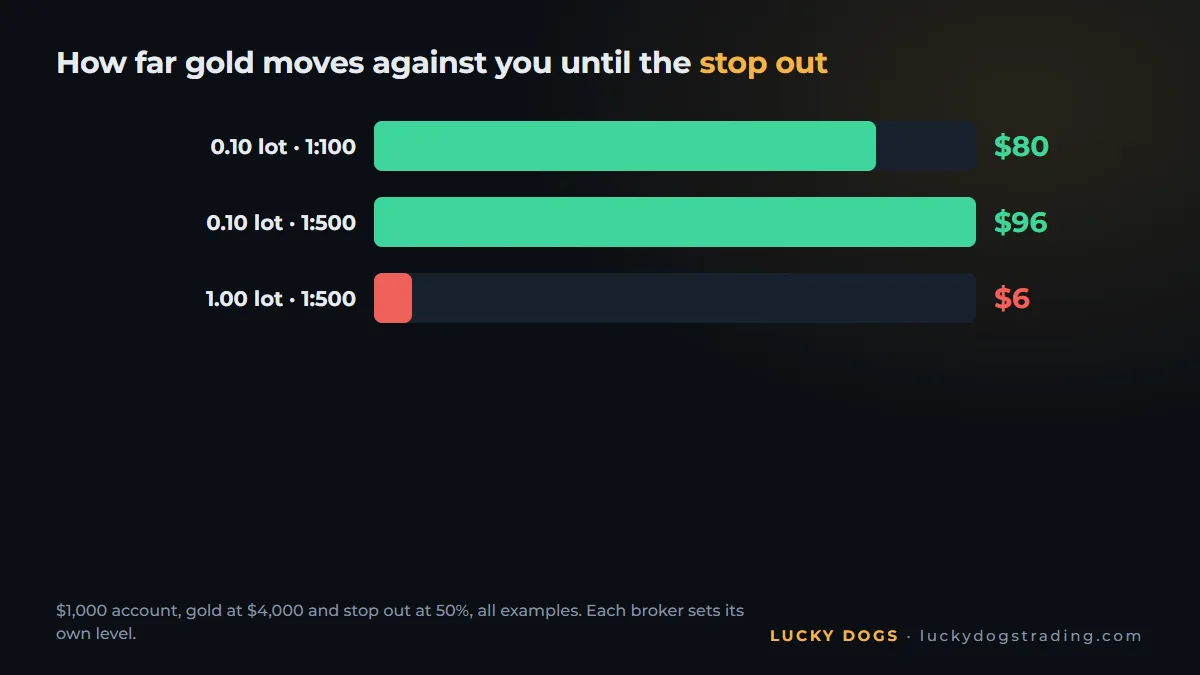
To see the real difference, put both on the same account: a 1,000 USD balance, gold at 4,000 USD and a broker with a 50% stop out, all three as examples. The stop out is the point at which the broker starts closing positions on its own. It's measured by the margin level, the account's equity divided by the margin used, as a percentage.
| Position | Margin | Margin level on opening | How far gold moves against you to an example 50% stop out |
|---|---|---|---|
| 0.10 lot at 1:100 | 400 USD | 250% | 80 USD |
| 0.10 lot at 1:500 | 80 USD | 1,250% | 96 USD |
| 1 lot at 1:500 | 800 USD | 125% | 6 USD |
| 1 lot at 1:100 | 4,000 USD | won't open: not enough margin | n/a |
Reading it takes two steps:
- With the same lot, higher leverage helps. 0.10 lot at 1:500 ties up 80 USD instead of 400 USD. More free margin is left, and the stop out moves a little further away: from 80 USD to 96 USD of movement against you.
- What brings the stop out close is the lot. With 1 lot, on the same account and the same leverage, gold only has to move 6 USD against you. From 96 USD to 6 USD, and the leverage didn't change.
1:500 isn't the danger. The danger is using 1:500's room to open 1 lot on a 1,000 USD account.
The 50% stop out is only an example: every broker sets its own. Where to check yours, and how each of these numbers is calculated, is in margin level, free margin and stop out in MT5.
Which leverage to choose if you're starting out
The one that lets you open your plan's lot with room to spare on margin. High leverage doesn't force anyone to open a big lot: with the same lot, it just leaves more free margin. What decides each trade's risk is the lot, together with the stop you set.
What leverage a robot needs
If you're going to turn on a trading robot, an EA (Expert Advisor) in MetaTrader 5, the question changes. It's no longer "what leverage do I want" but "what leverage does it need". Each EA ties up margin in its own way, and its page should state the minimum. Ours do:
| EA | Leverage | Account |
|---|---|---|
| Pitbull Gold | 1:100 or higher, on any profile | From 100 USD |
| Beagle Gold | 1:100 or higher, on any profile | From 1,000 USD |
| Collie Gold | 1:500 or more on any profile; at 1:100, Moderate at most | From 300 USD |
Pitbull Gold, which runs at 1:100 on any profile, is the direct answer for anyone with a 1:100 account. Every trade has one entry, no grid, with the target and stop already on the broker's server. In the test with real ticks, it made +425% in 2025 on the Balanced profile and closed 22 of 22 months in profit in 2025 and 2026.
Beagle Gold also runs at 1:100 on any profile. You choose from 1% to 5% of the balance per trade, and it never has more than two trades open at the same time. In the test with real ticks, it made +184% in 2025 on the Moderate profile.
Collie Gold needs more room: 1:500 or more on any profile; at 1:100, Moderate at most. It opens short baskets, groups of entries with the same lot, and each open entry ties up its own margin. At 1:500, the same basket ties up five times less margin than at 1:100. In the test with real ticks, it made +586% in 2025 on the Moderate profile.
On all three, the lot comes from the balance and only grows when the balance grows. The room leverage leaves never turns into a bigger lot.
The leverage in each EA's test
The sheets for our tests with real ticks use 1:1000 on Collie Gold, 1:500 on Pitbull Gold and 1:100 on Beagle Gold. To redo the test and check the number on the page, use the sheet's leverage. Then run it again with your account's leverage: that's the test that shows the EA in your reality. The step-by-step is in how to test a trading robot before you buy.
Where to see and change your account's leverage
Leverage belongs to the account, and the broker sets it. You choose it when you open the account and can usually ask for a change later, in the client area.
In some countries, the maximum leverage for retail clients is capped by regulation. So check your account's leverage before choosing the EA and the lot.
In MetaTrader 5, its effect shows in the Toolbox (Ctrl+T), Trade tab. The bottom line shows Balance, Equity (which already counts open positions), Margin, Free margin and Margin level. Open a small position on a demo account and watch the margin change along with the lot.
Frequently asked questions
What's the best leverage for forex beginners?
The one that lets you open your plan's lot with room to spare on margin. It doesn't increase each trade's risk: the lot does. With our EAs, 1:100 is enough for Pitbull Gold and Beagle Gold on any profile, and Collie Gold needs 1:500 or more (at 1:100, Moderate at most).
Is high leverage riskier?
On its own, no. The same lot wins and loses the same at 1:100 or at 1:500, and at 1:500 more free margin is left. It only matters when the room turns into a bigger lot than the account can take.
Does leverage change pip value?
No. Pip value depends on the lot and the contract: on 0.10 lot of EUR/USD, each pip is worth 1 USD at any leverage. See what 1 pip is worth in forex and gold.
How do I calculate the margin for a trade?
Lots × contract size × price ÷ leverage. With gold at 4,000 USD (example), 0.01 lot at 1:500 ties up 0.01 × 100 × 4,000 ÷ 500 = 8 USD.
What happens when the margin runs out?
First comes the margin call, the warning that the margin is running out. If equity keeps falling, the stop out follows: the broker starts closing positions on its own. Each broker sets both levels, and the full math is in margin level, free margin and stop out in MT5.
Choose the leverage by the robot and the lot by your plan. If your account is 1:100, Pitbull Gold runs on any profile: download the free demo and run 2025 and 2026 in the Strategy Tester with your account's leverage. At 1:500 or more, compare the three side by side and choose by your own test.