XAUUSD day trading strategy: 5 setups and when to use them
By Fernando Funicelli · Founder of Lucky Dogs Trading Systems
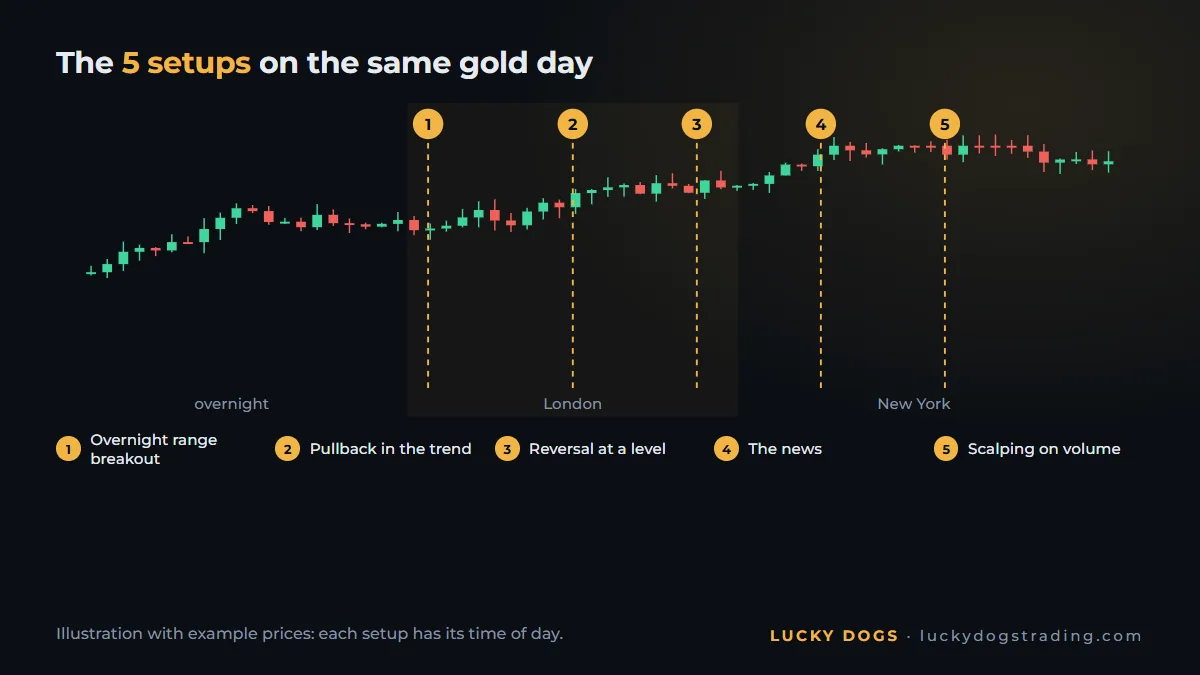
The best XAUUSD day trading strategy is the one with entry, stop, target and time written down before the trade, and that you have already tested. In gold day trading, the 5 classic setups are the overnight range breakout, the pullback with the trend, the reversal at a strong level, trading the news and scalping.
Gold sits still through the night. At the London open, a big candle breaks the range, and soon the price has moved tens of dollars. You look at the chart afterwards and think: I could have caught that.
You could. The problem is the next day. Anyone who trades gold without a written strategy changes setup after every loss: buys the breakout that falls back into the range, sells the reversal that doesn't reverse and, on payroll day, lets the spread decide for them. At the end of the month, every trade had a different reason, and none of them can be repeated.
The rule that changes this: in gold, the strategy is not the entry signal: it is the stop, the lot and the time that come with it.
Day trading gold: what it is and why XAUUSD attracts people
Day trading gold means opening and closing the trade on the same day. That has a practical advantage: a position open at the broker's day rollover pays or receives swap, and whoever closes earlier doesn't pay.
And XAUUSD attracts day traders for three reasons:
- It moves. Gold usually moves a lot within a single day, and movement is what pays those who trade short. In general, it moves more when London and New York are open.
- Almost all day. At most brokers, gold trades from Monday to Friday almost without a break, with a short pause each day.
- You start small. On the most common contract, 100 ounces, each 1 USD that gold moves is worth 1 USD in the account with 0.01 lot, and 10 USD with 0.10. The full math is in what 1 pip is worth in forex and gold.
If XAUUSD is still new to you, the symbol, the lot and the order with a stop on MT5 are in what XAUUSD is and how to trade gold on MT5. Here, the subject is the strategy.
The best XAUUSD strategy: the 5 day trading setups
Each setup comes with the same sheet, so you can compare one with another. The prices are examples, to show the math.
1. Overnight range breakout
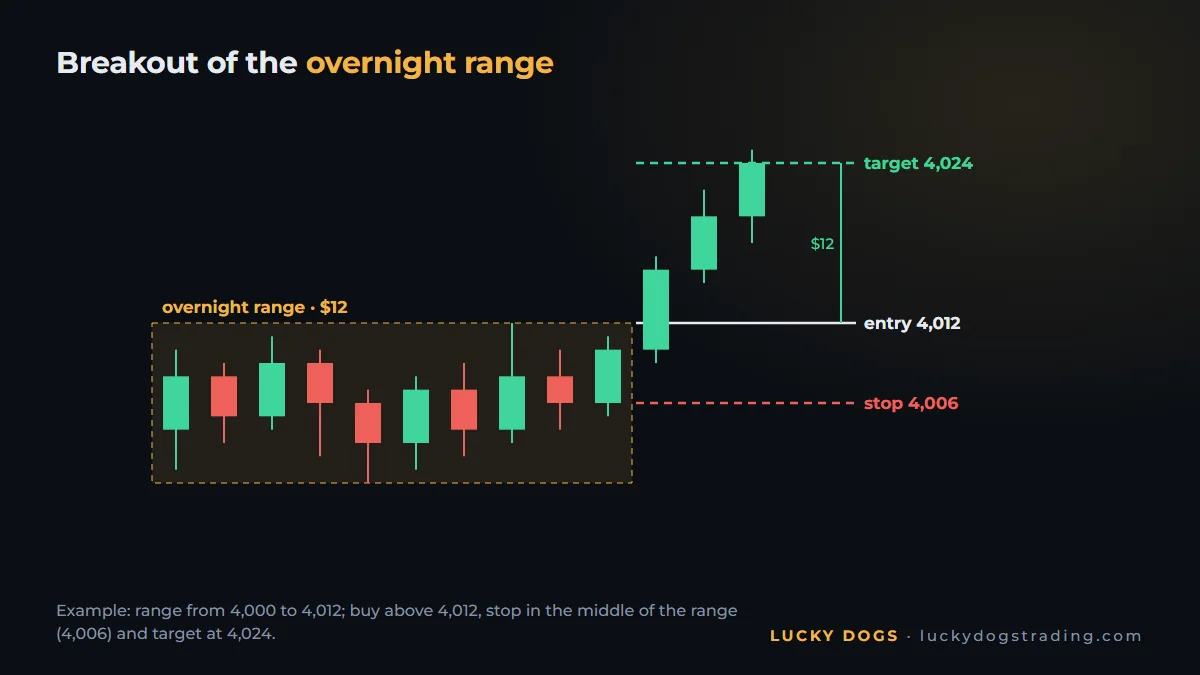
- The idea: overnight, gold usually moves sideways in a narrow range. When London opens and volume comes in, it picks a direction.
- The entry: the close of a candle outside the range. Above the high, buy; below the low, sell.
- The stop: on the other side of the range, or in the middle of it, for a shorter stop.
- The target: a multiple of the range size. The simplest is the range size itself, projected from the breakout.
- When it works: on a trending day, when the breakout gains follow-through.
- When it fails: on a sideways day, when the price breaks out, goes back inside and hits the stop.
An example with numbers. The overnight range runs from 4,000 to 4,012: 12 USD tall. A candle closes just above 4,012, and the buy goes in, at about 4,012. The stop sits in the middle of the range, at 4,006, and the target, 12 USD above the breakout, at 4,024. With 0.01 lot, the stop costs about 6 USD and the target pays about 12 USD.
The time of the London open on your chart depends on your broker's time zone and on daylight saving. The detail is in the guide on the best time to trade XAUUSD.
2. Pullback with the trend
- The idea: in a trend, gold moves in waves: a push, a pullback, another push. The pullback setup enters on the way back, not on the push.
- The entry: the retracement to the moving average or to the level that was broken, with a resumption candle in the direction of the trend.
- The stop: beyond the extreme of the retracement. On a buy, below its low.
- The target: the previous high, or more if the trend continues.
- When it works: with a clear trend, higher highs and higher lows (or lower, on a sell).
- When it fails: when the "retracement" is the start of the reversal.
An example: gold has been rising since the morning and comes back to the moving average, at 4,030. A candle closes strongly up at 4,032, and the buy goes in. Stop below the low of the pullback, at 4,027; target at the previous high, at 4,046. The trade risks 5 USD to go for 14 USD.
3. Reversal at a strong level
- The idea: the previous day's high and low and round numbers, like 4,000 and 4,050, are levels the whole market sees. When the price reaches one of them and is rejected, the reversal goes for the other side of the day.
- The entry: only with confirmation, a rejection candle at the level, with a long wick and a close back inside. Never on the touch.
- The stop: on the other side of the level, beyond the wick.
- The target: the middle of the day's range, or the opposite level.
- When it works: on a sideways day, with the price swinging between levels.
- When it fails: on a trending day, when the level gives way and becomes a breakout. The confirmation is there so you don't end up against the breakout before you see the rejection.
4. The news: trade after the first move, or stay out
- The idea: the Fed's rate decision, payroll (the monthly US jobs report) and US inflation move gold in seconds, with jumps and a wide spread.
- The entry: never in the second of the news. Either you wait for the first move to settle and enter on the retest, or you don't enter.
- The stop: beyond the extreme of the first move, with the lot adjusted for that wider stop.
- The target: the continuation of the first move, at a modest target: at that hour, the price moves hard in both directions.
- When it works: when the news changes the direction of the day and the move continues.
- When it fails: in the whipsaw, when the price jumps, gives it all back and jumps again.
Staying out is also a strategy. It is the path of Collie Gold, one of our EAs: Fed and payroll days are left out.
5. Scalping in the highest-volume hours
Scalping is trades lasting minutes, with short targets and stops, in the hours when gold has the most business. It is often one of the previous setups, on a 1-minute chart.
What changes is the cost. With a small target, the spread and the commission become a large slice of each gain. An example: on a 2 USD target, a 0.30 USD spread already takes 15% of what the trade is going for. That is why scalping calls for the lowest-cost account you can find and the hours of tight spread.
The rest of the subject is in the guide on scalping gold: what it is and what a scalper robot needs.
Which setup suits you: the comparison table
| Setup | Market where it works | Where it tends to fail | Screen time |
|---|---|---|---|
| Range breakout | trending day | false breakout, sideways day | at the London open |
| Pullback | clear trend | market reversal | throughout the day |
| Reversal at a level | sideways day | trending day | near the levels |
| News | Fed, payroll, inflation day | wide spread and jumps | at the time of the news |
| Scalping | highest-volume hours | cost too high for the target | a lot |
There is no best setup for every day. There is the one you execute the same way every day. And executing the same way depends less on the entry than on the pieces that come with it.
What every gold setup needs
The entry changes from one setup to the next. These six pieces don't.
- A stop set from the entry. The safest is a stop on the broker's server: filled in on the order, it stays there if your computer shuts down. A robot that executes its own stop needs MT5 running all the time, and a VPS is the simple way.
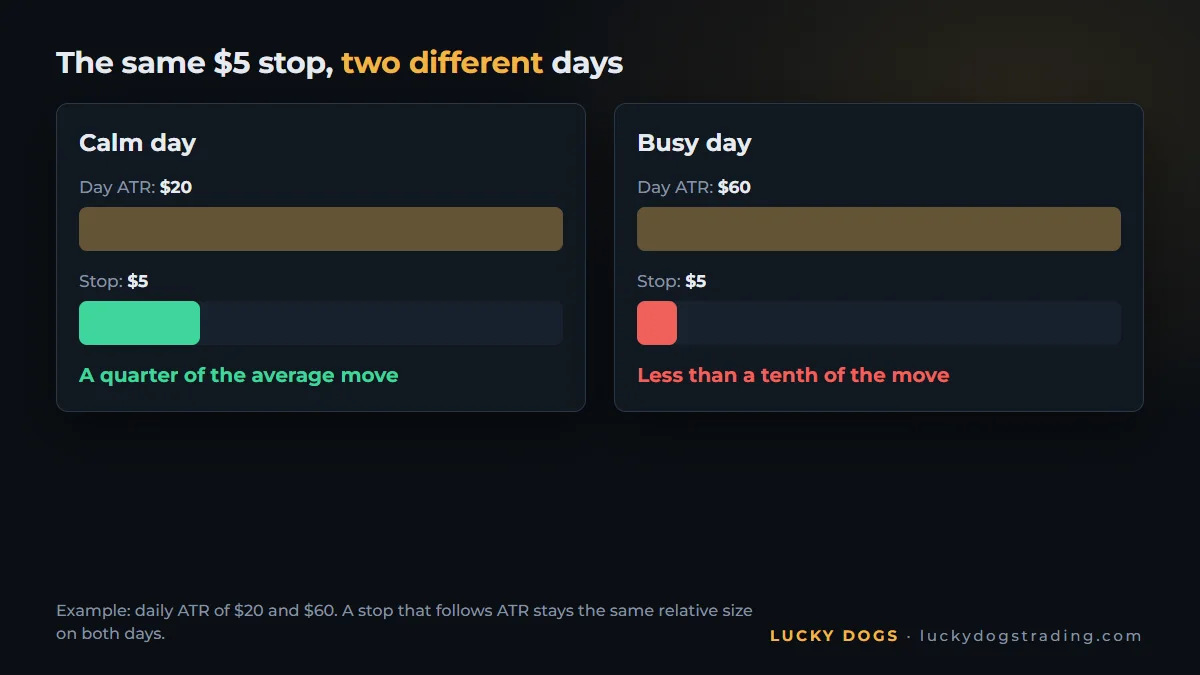
- A stop sized by the day's movement, not by fixed pips. The same 5 USD stop is roomy on a calm day and short on a busy one. ATR, the average size of the candles, measures that. On a day with a daily ATR of 20 USD (example), a 5 USD stop is a quarter of the average move. With an ATR of 60 USD, it is less than a tenth, and any breath of the price reaches it.
- A lot sized by the money at risk. First, how much you accept losing on the trade; then, the lot that fits. Example: on a 1,000 USD account, with 1% risk (10 USD) and a 5 USD stop, the lot is 0.02, because at that lot each 1 USD of gold is worth 2 USD.
- The cost in the account. Spread, commission and the wide spread of the news go into the target calculation, not after it.
- No recovering with the lot. No doubling after a loss. That is martingale, the shortest path from a bad day to a blown account.
- The rule written beforehand. Entry, stop, target, lot and time on paper, so it is the same on the first and on the hundredth trade.
Best indicator for XAUUSD: what each one does in the setup
| Indicator | What it shows | In which setup it helps |
|---|---|---|
| Moving averages | the direction of the trend | pullback |
| ATR | the size of the day's movement | the stop and target of all of them |
| Previous day's high and low | the day's levels | reversal and breakout |
| The overnight range | where gold stood still | breakout |
| RSI | whether the move has stretched | reversal, only with confirmation |
| Economic calendar | the time of the news | news, and to know when to stay out |
The indicator is not the strategy: it is the ruler inside it. Moving Average, ATR (Average True Range) and RSI (Relative Strength Index) come with MT5, in the Navigator's list of indicators. The overnight range and the previous day's levels you mark with lines on the chart itself. And the economic calendar is in the Toolbox, in the Calendar tab.
How to test your XAUUSD trading strategy
A strategy is only worth something once it has been tested, and the test starts on paper.
- Write the complete rule: entry, stop, target, time and lot. If two people read the rule and make different trades, it is not written yet.
- If the rule is in a robot, the MT5 Strategy Tester, with real ticks, shows trade by trade what it would have done. On gold, this matters more: a short stop and target fit in the same 1-minute candle, and only the real tick says which came first. The step by step is in how to backtest on MT5.
- If you trade by hand, use a demo account and a journal of every trade: the setup, the entry, the stop, the target, the result and whether you followed the rule. Start with the most recent market.
The last column of the journal is the most important. It shows whether the problem is in the strategy or in the execution.
Our EAs: three ways to automate gold
The hard part of gold day trading is not knowing the setups. It is executing the same rule at 3 a.m., on news day and after three losses in a row. That is the work an automation does without getting tired, without skipping a trade and without trying to get revenge on the market.
Our three EAs trade gold on MetaTrader 5, each with its own way of finding the moment:
| EA | How it finds the moment | Pace | In 2025, in the real-tick test | Maximum continuous drawdown |
|---|---|---|---|---|
| Collie Gold | short baskets, groups of entries with the same lot; Fed and payroll days are left out | the typical basket stays open 8 minutes; 82% close in under 1 hour | +586% (Moderate) | 37% |
| Pitbull Gold | waits for gold to confirm the move and enters with target and stop on the server | 10 trades a month, on average | +884% (Balanced); 21 of 22 months in profit in 2025 and 2026 | 49% |
| Beagle Gold | you choose from 1% to 5% of the balance per trade; at most two trades open | 36 trades a month, on average | +184% (Moderate); 21 of 22 months in profit in 2025 and 2026 | 27% |
On all three, the lot grows with the balance, without martingale: each gain increases the next trade, compound interest on autopilot. All three recognize gold under any name and detect the broker's time zone on their own. Pitbull Gold and Beagle Gold send the stop to the server with the order. On Collie Gold, every basket has a stop, executed by the EA itself: that is why it needs MT5 on all the time, and a VPS is the simple way.
If setup 4 convinced you that staying out is also a strategy, Collie Gold does that on Fed and payroll days. If your favorite piece is the lot sized by risk, on Beagle Gold you choose the slice of each trade. If you want every entry with the target and stop already in place, it is Pitbull Gold.
Compare the three side by side and run the free demo in the Strategy Tester of your MT5, with your broker's data.
Frequently asked questions
What is the best XAUUSD strategy?
The one with a written rule, a stop set from the entry and a lot sized by risk, that fits your routine and was tested beforehand. Among the 5 setups, the best one for you is the one that fits your day: the breakout needs the London open, the reversal needs patience near the levels, scalping needs a lot of screen time. No strategy is right every time; the one you execute the same way every day is the one that has a chance to show its edge.
Can you day trade gold with little money?
You can. On the most common contract, with 0.01 lot, each 1 USD that gold moves is worth 1 USD in the account. What limits you is not the balance: it is whether the stop fits the risk you accept per trade. If you would rather automate gold, our EAs start from 100 USD on Pitbull Gold, 300 USD on Collie Gold and 1,000 USD on Beagle Gold, with the recommended amount on each one's page.
What is the best timeframe for gold day trading?
The setup decides. A common arrangement is the 1-hour chart for direction and the 5- or 15-minute chart for entry; scalping drops to the 1-minute chart. Pick one and stay on it: changing timeframe in the middle of a trade is changing strategy without noticing.
What is the best indicator for XAUUSD?
None on its own. ATR is the one every setup uses, because it sizes the stop and the target by the size of the day. The others depend on the setup: moving averages on the pullback, the previous day's levels on the breakout and the reversal, the economic calendar on the news.
Does gold day trading pay swap?
No, if the position closes before the broker's day rollover. A position open at the rollover pays or receives swap; whoever closes earlier doesn't pay.
Can you automate gold day trading?
You can. An EA, the MetaTrader 5 robot, executes the rule the same way on every trade, day and night, including in the hours when you are not at the screen. The rule needs the same pieces as a setup: entry, stop, target and lot. Our three EAs automate gold, each at its own pace, with a free demo to test before you decide: compare side by side.
The setup is the easy part. Executing the same rule every day, with stop, lot and time, is what separates the trader from the gambler. If you prefer a tested rule to do that for you, compare our three EAs for gold and run the free demo in your MetaTrader.